The future is not quite real-time

In a discussion with Lawrie Phipps (@Lawrie) I was reminded of something I was thinking about last year around the advantages of not quite real-time (NQRT). It’s one of the few genuinely unique affordances of the web. Asynchronous communication has been with us since cave painting and synchronous since two people first clapped eyes on each other. What is relatively new is the cultural acceptability of having anywhere between 10 seconds and 10 hours between contributions to a discussion or conversation (although between 10 seconds and around 5 minutes is the more interesting time-frame).

Egg Timer

Photo by Ian Barbour: http://goo.gl/Kojve

I’m thinking here about ‘Instant’ messaging, a Twitter stream, a Facebook wall and even ‘rapid’ emailing or forum posting. For example, I can receive a text message in Skype, check the web for information or speak to a colleague in the room and then respond. It’s powerful because it doesn’t demand the immediate attention of a f2f encounter or a ringing phone and it also gives me time to gather my thoughts/cross check information.

Not quite real-time is the main reason why most people are wittier, cleverer and all together more attractive online than they are f2f (note, I say ‘are’ not ‘appear to be’ – the web is real and so are the things that happen there…). It’s also a key reason why more people are comfortable to be perfomative on Facebook walls and in Twitter streams i.e. visible social interaction. This is a communication mode in which we feel a sense of interpersonal connection but also have some level of control over pace/timing. It’s a powerful because it’s social but doesn’t aggressively demand attention. This is why text will always be the dominant visible form of communication online and why many of us chose to not put our cameras on when Skyping.

The downside of NQRT is when it’s used as part of a focused event or discussion with more than two participants. In these cases the pace tends to increase rapidly until NQRT becomes achingly close to f2f speeds (4 seconds is about the maximum time between responses in a f2f conversion ) and the thinking-time gaps are crushed. When this happens the quickest thinkers and fastest typists win-out (or those who have pre-prepared text which they paste in…). This is why text-chats are often feel so exclusive, especially in an educational context – the usual suspects take the floor. It could be one of the many modes of engagement which erode when shifted from a personal to an institutional context?

It would be fascinating to study the nature of NQRT communications because it appears to be unique to the web and a relatively new cultural phenomenon. What is effect of NQRT on maintaining relationships and/or supporting communities? Is it a more inclusive form because it levels out the playing field and those who like to muse before expressing themselves can be part of the flow or is it fated to always speed-up and lose its advantages as soon as a discussion becomes interesting? It’s certainly something that warrants research, assuming a practical methodology could be developed…

Sesame: talking to practitioners

In addition to producing Open Educational Resources (OER), one of the main aims of the Sesame project has been to embed open ways of working in the development and delivery of the Department’s Weekly classes programme. In particular we wanted to work with the large cohort of part-time tutors who teach these courses to improve their skills and confidence in identifying, using and creating OER. Now that we are just over half way through the project, we took the opportunity to talk to some of our tutors about their experience of participating in the project. This short video provides a brief introduction to the Sesame project and some reflections from tutors on the impact the project has had on their teaching practice.

To find out more about the project, and to browse the resources released so far, visit: http://open.conted.ox.ac.uk.

The video is published under a Creative Commons Attribution licence (CC BY NC SA)

Extending opportunities for lifelong learning: Cascade

Although the Cascade project has been technically complete for over a year, its legacy is definitely alive and well in the Department.  As we are in the middle of extending online assignment submission and VLE support for courses to even more of our offerings, it is timely to be able to share the video case study developed by JISC as part of their publication Learning in a Digital Age – extending opportunities for lifelong learning.  As well as the video below, there is more about the project in the publication itself.


In particular it is a great overview of how we are using technology to continue our historical Departmental mission, something that would not be possible without all the great contributions from our academics, support staff and students.

Online support site: From IT support to digital literacies

For several  years now we have had a comprehensive Online support site for our students, designed to provide them with somewhere to go to for help before they phone up our IT support guys with questions we have already told them the answers to in 5 places, as well as other bits of useful information we think students might want to know.  Several years ago now as part of the JISC funded Isthmus project we created a set of resources around what we then called “new media literacies” (yes we were trying to support digital literacies before they even had a name….).  This was a pretty basic set of resources covering areas such as online information sources, citation tools, searching online, we branded it learning support and didn’t give it much further thought.

Rolling forward to our termly review of course delivery we were looking at the stats for our support site, and realised that with the exception of obvious lures such as our 2 minute guide to Moodle (ave time spent on page 1 min 56) and logging into your course, the most visited pages are largely from the “digital literacies” subsection of the site.

I don’t think we can draw any major conclusions from this, but you can at least say our students increasingly don’ t seek help with basic IT skills, but may be looking to improve their wider skill set.


Sesame Evaluation – Baseline

Golden Genie (http://www.flickr.com/photos/phototacular/487233900/) / Mustafa Al-ammar (http://www.flickr.com/photos/phototacular/) / CC BY-NC-ND 2.0 (http://creativecommons.org/licenses/by-nc-nd/2.0/)

Now that we are in our second term of producing OER we are really moving forward with  evaluating our experiences and reflecting on what this means for the rest of the project.  Thus far our main activities have been an initial baseline survey of our weekly class tutors, surveying students and tutors involved in our first pilot in Hillary term, and a focus group of our main stakeholder groups.  We have also been engaging with the OER synthesis and evaluation team and our “evaluation buddy” the FAVOR project.  I hope to blog about all of these over the next few weeks, but for the moment just wanted to revisit our starting point, the weekly class tutor baseline survey.

For this we canvassed the opinions of our weekly class tutors on issues around teaching and learning, technology use, open resources and more. To begin, it is worth noting our tutors teach all subjects (we had responses from 62 tutors covering 23  disciplines), are all ages (with 40%+ over 55), and have teaching experience from under 2 years to over 20. However the vast majority (just under 80%) are employed sessionally on part-time contracts.

In terms of engagement with OER, nearly 40% had heard of OER prior to our project which was higher than anticipated. This continued with nearly 30% having used OER in their teaching and learning and 7% already producing OER.  This may be a function of a self selecting sample but still indicates a relatively high level of engagement.

Generally our tutors felt that OER were ‘a good thing’.  However they were clearly more comfortable simply putting content online rather than making it fully open, as just over half expressed concern about what happens when content is openly released.  In terms of reasons to engage with OER, our tutors self-reported being far more interested in the altruistic reasons for engagement: “it is a good thing to do”, “student learning will be improved” or “[it brings] benefits to the institution”, rather than the potential personal gains, either financial or reputational.  Interest in training was highest in the area of how to find good resources and how best to use them.

On a more pragmatic note, the survey confirmed our initial thoughts that one of our biggest challenges in terms of making content associated with our weekly class courses online and open is the fact that, with the exception of reading lists, those resources which tutors most often currently make available to students in hard copy are often those which cannot usually be openly licensed, such as photocopies of book chapters and journal articles, copies of photographs, diagrams, maps or illustrations and copies of primary sources.  Thus much perfectly legitimate classroom practice thwarts the promise of seamless sharing and openness.

While getting the survey written at the start of the project was not a trivial task, we were able to put reuse in action, using Chris Pegler’s  Oriole survey as a basis for many questions.  There is also no doubt this sort of information was great in terms of understanding  our key audience from the start, as well as specifically helping us shape our communications and training plans.

Photo: Golden Genie (http://www.flickr.com/photos/phototacular/487233900/) / Mustafa Al-ammar (http://www.flickr.com/photos/phototacular/) / CC BY-NC-ND 2.0 (http://creativecommons.org/licenses/by-nc-nd/2.0/)

Education should move us

Last week I was involved in the ‘New Places to Learn’ HEA event held at the Said Business School in Oxford. The focus of the event was Flexible Learning and online Residency. It was my job to frame the day by laying out the Visitors and Residents metaphor and encourage the participants to consider the relevance of the Resident end of the continuum.

It’s a complex area and one which the HE sector is only just beginning to consider properly. It’s not clear where the boundaries lie (or even if there should be boundaries) in terms of ownership, roles and time.

Academic and Personal Development in the context of Visitors and Residents

Academic and Personal Development in the context of Visitors and Residents (Photo by Josie Fraser)

What is becoming clear, as mentioned by Alison Le Cornu, is the cultural shift away from the institution and towards the individual. With the erosion of the job-for-life principle our learning and professional progression is rarely framed by a single institution. Over time we are likely to become temporarily tethered to a sequence of institutions or to clusters of institutions. Any continuity is likely to be provided by our activity or presence online, the web providing the meta-place in which, to a certain extent, all the institutions we encounter exist. The continuity I’m referring to goes beyond the notion of the CV or even the ePortfolio, it includes the knowledge we produce and the communities/networks we belong to. The web allows the individual, beyond the institution, to become the hub that knowledge and value clusters around. Our relationships with institutions lend weight to the knowledge we produce and to our influence, but they no longer own those aspects of our persona as wholly as they used to.  As an example consider the movers and shakers in the field of Edtech – do they mainly blog under an institutional banner or as ‘themselves’?

This has always been the case for the high-flyers or the ‘thought leaders’ in many fields but the ubiquity of the web is giving those of us in more humble positions the opportunity to operate beyond the institution.

Will this be the predominant professional and learning mode-of-operation in the near future?

Those promoting Digital Literacies as more than a simple set of skills, such as JISC, certainly seem to think so. Their descriptions of ‘Digital Literacies’ often incorporate words like ‘professional, ‘lifelong’ and ‘personal’ in the same sentence. This broad remit which has been fostered by the social-web is also reflected in many of the graduate attributes universities aspire towards. For example, Brookes University talks of graduates ‘…engaging productively in relevant online communities’ while Southampton University promotes the importance of  using technology ‘…to work, research, learn and influence others in an increasingly digital world’. In my talk at New Places to Learn I proposed that to gain these ‘attributes’ individuals would increasingly need to engage with the web in a Resident as well as a Visitor mode.

At the event Dave Cormier proposed that the role of education should be to equip learners with the ability to cope with uncertainty, that we should be encouraging agile, innovative thinkers who can move and create in rapidly changing sectors. He suggested that having a ‘Resident’ approach online is now an important element of that agility.

Lindsay Jordan and Dave Cormier

Lindsay Jordan and Dave Cormier - (Photo by Josie Fraser)

It could be the case that building an extra-institutional persona and engaging with professional communities online is a good way to respond to increasing uncertainty? Is a Resident approach an opportunity for individuals to become more resilient at a time when institutions are becoming less so?

Even if this is the case many find being visible in their practice online stressful. Reflecting on her own teaching practice Lindsay Jordan highlighted that moving students from a Visitor to a more Resident mode online is often a painful process. She spoke of how distressing encouraging her students to start sharing in an open manner via blogging was – distressing both for her and for them.

Alan Cann spoke about his use of Google+ with students and showed that although they all had profiles on the platform their modes of engagement were actually spread evenly along the Visitor Resident continuum. It was clear that some students were tentative about sharing their thoughts and themselves online and engaged only because activity within the social media platform was being assessed. As a sector we struggle to engage students at the Resident end of the continuum and haven’t yet found elegant ways of activating learner-owned-literacies in an institutional context.

Last year I blogged about how I felt education should make us anxious. It’s a fine line to tread but I think it’s the role of the educator to push learners in this way. This is what Lindsay has been doing and it sounded like a tough but ultimately rewarding journey.  If we are going to equip learners to live and learn in an uncertain world it will surely involve a certain amount of pain and anxiety?

While I don’t think that a Resident mode of engagement is ‘better’ than a Visitor mode I am beginning to realise its importance in equipping individuals to become resilient beyond a single role or institution. Moving is always a painful process and this holds true when we move to inhabit ‘places’ online. The anxiety that this causes is, in my opinion, part of what it is to learn. Whatever our direction of travel education should move us.

My slides from the day:

Book boxes to OER: opening up Oxford

A mountain of book boxes from Rewley House library

A mountain of book boxes from Rewley House library

A couple of months ago while filming a video about our work on the Cascade project with JISC we visited the  mountain of  book boxes that are in the basement of our library.  These are  legacy from the days gone by of the department, when opening up access to Oxford meant traveling around the UK by train, with your TRAVELLING LIBRARY  and giving lectures.

The interior label from an early book box

The interior label from an early book box

It is worth noting that although we now offer many online courses this does actually still happen, with the occasional church hall still hosting a book box as we speak.  There is more about the history of the department on our website, acting as a reminder that exploring how best to open up education is not a new pursuit, and that projects such as Sesame and the generation of OER are just the latest evolution of this work.

New Places to Learn

Yesterday I tweeted:

“Annoyed by the ‘Digital Natives’ idea? Explore alternatives: ‘New Places to Learn’ Oxford Apr19 http://goo.gl/Sdf3w

The (free) event I’m referring to is being run by the HEA and is using the Visitors and Residents metaphor  as a broad framework to explore the implications of the web as a ‘place’ for the education sector. The intention is to break away from outmoded age or tech skill related correlations to discuss new modes of engagement which are emerging based on co-presence online. To put it in ‘Visitors and Residents’ terms: exploring pragmatic approaches to operating at the Resident end of the continuum.

Visitor restrictions

CC: A-NC-SA Flickr: 'Celita'

The danger when learning is moved online is that the focus tends to be on curriculum and content rather than the less instrumental aspects of what makes a course work such as social cohesion and a sense of belonging. The traditional lecture in a physical space may not be pedagogically ideal but it has inherent co-presence, giving students the sense that they belong to a particular cohort and that they are legitimate members of their institution. These ‘side effects’ of traditional modes of engagement are easy to take for granted and often forgotten in the move online.

This move is a response to increasing student numbers, the need to deliver learning with greater flexibility, the availability of online resources (some of which are in ‘beyond text’ formats) and the desire to attract oversees students. The underlying drivers here are efficiency, flexibility and scalability. As we discovered in our HEFCE Study of Online Learning one of the key pedagogical design approaches that can address these drives is that of peer learning.  This is a form of inter-student support and collaboration that is well supported by the physical institution. The library, the coffee shop, the pub etc have all evolved to create ‘places’ for, amongst other things, peer-learning. As a sector we haven’t been very successful to-date in creating or using similar places (or places which facilitate similar forms of interaction) online and we often underestimate the importance of co-presence when trying to encourage peer-learning on the web.

It is  generally accepted that it’s  easier to discuss learning with a fellow student you ‘know’ than with a stranger so if that learning is taking place predominantly online it’s crucial that your fellow students have an online social presence. If the majority of a cohort have a social presence online  it is more likely that individuals will feel that all important sense of belonging and accountability which will support them though the challenging aspects of their study (especially when the course is large scale and tutoring staff don’t have the time to keep a close pastoral overview).

Understanding the role and value of Resident/presence based modes of engagement should be a high priority for a sector that is moving online. It should no longer be the exotic preserve of the ‘high tech’ or the ‘innovator’ and needs to be taken up by the ingenious pragmatists amongst us. I am very happy to say that the ‘New Places to Learn’ event has secured the services of a number of these ingenious characters who will discuss the challenges of working at scale online from different perspectives:

  • Dave Cormier comes to the ‘web as place’ as one of the early instigators of the ‘MOOC’ format which builds on the inherent connectivity of the web to form agile learning scenarios. I think of this approach as highly Resident, emerging from the culture of the web and loosely tethered to the traditional institution where necessary.
  • Martin Weller has been involved in moving large scale Open University courses online as well as initiatives such as Open Learn. He understands what is involved when a large organisation reaches out into the web and what it means to be a ‘Digital Scholar’ online.
  • Lawrie Phipps and Ben Showers from JISC will be facilitating an activity which aims draw on the collective expertise in the room to map the pros and cons of Resident modes of engagement.

Alison Le Cornu the academic lead for Flexible Learning for the HEA will be chairing the day and drawing together the thinking to inform the strategic direction of the academy in this area.

I myself will be picking up on the themes in this post and discussing our JISC funded Visitors and Residents project which is in the early stages of describing educational/online ‘genres of participation’ and mapping the associated literacies which learners use.  We also hope to hear about the progress of  projects in the JISC Developing Digital Literacies strand.

If you are interested in the web as a place for learning or you have your own thoughts or practice to share then sign-up. If you can’t make it to Oxford then visit the HEA booking page on the day for a link to the live stream.

Open education week

We’ve been publicising open education week to our students this week, letting them know a bit more about what it means and what they might to explore further on our Departmental website.  While we took this chance to tell them about OER and open ed more widely, we also blew our own horn a bit too….

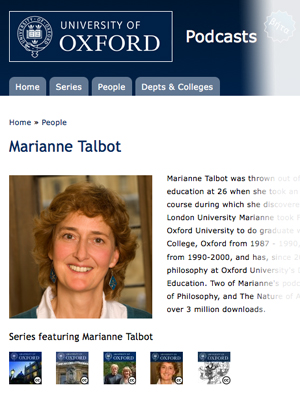
The Department for Continuing Education was one of the first departments to contribute to Oxford’s iTunes U site and Marianne Talbot, the Department’s Director of Studies in Philosophy, has had her lectures downloaded more than three million times with two of her podcasts – ‘A Romp Through the History of Philosophy’, and ‘The Nature of Arguments’ – being global number one on iTunes U. You can listen to Marianne’s lectures and other podcasts from the Department’s podcasts site.

As well as contributing to the University’s open education initiatives, the Department has undertaken research into the use of open educational resources by tutors and students and, where possible, releases the outputs of its teaching and learning projects as OER.

One example is the Course Design Moodle, which highlights examples from some of the Department’s online courses and aims to help teachers worldwide to develop their own high-quality online learning resources.

The Department is also embedding open practices across its work and has just started an exciting new project to create OER as part of the Weekly Classes programme. So far, the project has made available more than 150 online resources from 11 weekly classes and will be openly licensing these resources in the future. For a preview of the sort of material we hope to release see: open.conted.ox.ac.uk/.

Investigating politics, microeconomics and the Victorians

pluto-politician

Cartoon of a Victorian politician - who was surely interested in microeconomics.

For once thought I would seize the chance to tell you about our new courses when there is still time to enroll on them.  New for Trinity term we have Investigating the Victorians, Politics: an introduction and Microeconomics: an introduction.

Investigating the Victorians is a course bursting with amazing resources about Victorian lives and great activities to help you explore them.  Many of the themes this course explores are surprisingly relevant to the world today and you also get to do a quiz which has the possible choices….

…..Presence of dunghills, Filth, Slaughter houses, Dampness, Decomposing refuse, Open sewers and drains, Accumulation of refuse, Homes with no flooring, Inadequate diet and clothing, Overcrowding….

Remember modern life is not so bad.

The next two courses are possibly even better for holding forth on the state of the world today – justify your opinions with political and economic theory and impress your friends.

Microeconomics follows on where our Macroeconomics course left off, looking at economics on the smaller scale of firms and individuals, and helping you understand  what economic theory has to say about where we are now.

Our new Politics course is fabulously clear and straight forward entry into a huge topic, covering a vast amount of ground from ancient Greece via Machiavelli and J.S. MILL to the Japanese Tsunami and the War in Iraq.

So if you fancy an bit of intellectual stimulation in the spring check these out, or any of the other 50 courses we have to choose from.

Image:14 Pluto – Politician / Carl Guderian / http://creativecommons.org/licenses/by-nc-sa/2.0/