About Marion Manton

I amSenior Manager: Learning Design and co-manager of TALL with David White. Previous to that I was eLearning Research Project Manager. As well as the day to day running of TALL I am responsible for the ensuring that all TALL programmes are best practice examples of learning online for their audience. I work closely with course teams to specify the learning they want to achieve with their programme and to identify the best uses of technology to do this. I also maintain currency with the latest research in eLearning, to ensure that TALL is aware of and exploits the best current knowledge of what works in terms of effective eLearning. My particular interests are in effective pedagogical models for different learning scenarios and how best to facilitate these by the appropriate use of technology. As well as the development of effective tools and processes to help academics identify these and translate knowledge of their subject and teaching into high quality online learning.

Sesame: talking to practitioners

In addition to producing Open Educational Resources (OER), one of the main aims of the Sesame project has been to embed open ways of working in the development and delivery of the Department’s Weekly classes programme. In particular we wanted to work with the large cohort of part-time tutors who teach these courses to improve their skills and confidence in identifying, using and creating OER. Now that we are just over half way through the project, we took the opportunity to talk to some of our tutors about their experience of participating in the project. This short video provides a brief introduction to the Sesame project and some reflections from tutors on the impact the project has had on their teaching practice.

To find out more about the project, and to browse the resources released so far, visit: http://open.conted.ox.ac.uk.

The video is published under a Creative Commons Attribution licence (CC BY NC SA)

Extending opportunities for lifelong learning: Cascade

Although the Cascade project has been technically complete for over a year, its legacy is definitely alive and well in the Department.  As we are in the middle of extending online assignment submission and VLE support for courses to even more of our offerings, it is timely to be able to share the video case study developed by JISC as part of their publication Learning in a Digital Age – extending opportunities for lifelong learning.  As well as the video below, there is more about the project in the publication itself.


In particular it is a great overview of how we are using technology to continue our historical Departmental mission, something that would not be possible without all the great contributions from our academics, support staff and students.

Online support site: From IT support to digital literacies

For several  years now we have had a comprehensive Online support site for our students, designed to provide them with somewhere to go to for help before they phone up our IT support guys with questions we have already told them the answers to in 5 places, as well as other bits of useful information we think students might want to know.  Several years ago now as part of the JISC funded Isthmus project we created a set of resources around what we then called “new media literacies” (yes we were trying to support digital literacies before they even had a name….).  This was a pretty basic set of resources covering areas such as online information sources, citation tools, searching online, we branded it learning support and didn’t give it much further thought.

Rolling forward to our termly review of course delivery we were looking at the stats for our support site, and realised that with the exception of obvious lures such as our 2 minute guide to Moodle (ave time spent on page 1 min 56) and logging into your course, the most visited pages are largely from the “digital literacies” subsection of the site.

I don’t think we can draw any major conclusions from this, but you can at least say our students increasingly don’ t seek help with basic IT skills, but may be looking to improve their wider skill set.


Sesame Evaluation – Baseline

Golden Genie (http://www.flickr.com/photos/phototacular/487233900/) / Mustafa Al-ammar (http://www.flickr.com/photos/phototacular/) / CC BY-NC-ND 2.0 (http://creativecommons.org/licenses/by-nc-nd/2.0/)

Now that we are in our second term of producing OER we are really moving forward with  evaluating our experiences and reflecting on what this means for the rest of the project.  Thus far our main activities have been an initial baseline survey of our weekly class tutors, surveying students and tutors involved in our first pilot in Hillary term, and a focus group of our main stakeholder groups.  We have also been engaging with the OER synthesis and evaluation team and our “evaluation buddy” the FAVOR project.  I hope to blog about all of these over the next few weeks, but for the moment just wanted to revisit our starting point, the weekly class tutor baseline survey.

For this we canvassed the opinions of our weekly class tutors on issues around teaching and learning, technology use, open resources and more. To begin, it is worth noting our tutors teach all subjects (we had responses from 62 tutors covering 23  disciplines), are all ages (with 40%+ over 55), and have teaching experience from under 2 years to over 20. However the vast majority (just under 80%) are employed sessionally on part-time contracts.

In terms of engagement with OER, nearly 40% had heard of OER prior to our project which was higher than anticipated. This continued with nearly 30% having used OER in their teaching and learning and 7% already producing OER.  This may be a function of a self selecting sample but still indicates a relatively high level of engagement.

Generally our tutors felt that OER were ‘a good thing’.  However they were clearly more comfortable simply putting content online rather than making it fully open, as just over half expressed concern about what happens when content is openly released.  In terms of reasons to engage with OER, our tutors self-reported being far more interested in the altruistic reasons for engagement: “it is a good thing to do”, “student learning will be improved” or “[it brings] benefits to the institution”, rather than the potential personal gains, either financial or reputational.  Interest in training was highest in the area of how to find good resources and how best to use them.

On a more pragmatic note, the survey confirmed our initial thoughts that one of our biggest challenges in terms of making content associated with our weekly class courses online and open is the fact that, with the exception of reading lists, those resources which tutors most often currently make available to students in hard copy are often those which cannot usually be openly licensed, such as photocopies of book chapters and journal articles, copies of photographs, diagrams, maps or illustrations and copies of primary sources.  Thus much perfectly legitimate classroom practice thwarts the promise of seamless sharing and openness.

While getting the survey written at the start of the project was not a trivial task, we were able to put reuse in action, using Chris Pegler’s  Oriole survey as a basis for many questions.  There is also no doubt this sort of information was great in terms of understanding  our key audience from the start, as well as specifically helping us shape our communications and training plans.

Photo: Golden Genie (http://www.flickr.com/photos/phototacular/487233900/) / Mustafa Al-ammar (http://www.flickr.com/photos/phototacular/) / CC BY-NC-ND 2.0 (http://creativecommons.org/licenses/by-nc-nd/2.0/)

Book boxes to OER: opening up Oxford

A mountain of book boxes from Rewley House library

A mountain of book boxes from Rewley House library

A couple of months ago while filming a video about our work on the Cascade project with JISC we visited the  mountain of  book boxes that are in the basement of our library.  These are  legacy from the days gone by of the department, when opening up access to Oxford meant traveling around the UK by train, with your TRAVELLING LIBRARY  and giving lectures.

The interior label from an early book box

The interior label from an early book box

It is worth noting that although we now offer many online courses this does actually still happen, with the occasional church hall still hosting a book box as we speak.  There is more about the history of the department on our website, acting as a reminder that exploring how best to open up education is not a new pursuit, and that projects such as Sesame and the generation of OER are just the latest evolution of this work.

Open education week

We’ve been publicising open education week to our students this week, letting them know a bit more about what it means and what they might to explore further on our Departmental website.  While we took this chance to tell them about OER and open ed more widely, we also blew our own horn a bit too….

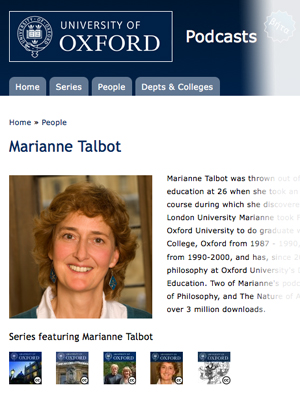
The Department for Continuing Education was one of the first departments to contribute to Oxford’s iTunes U site and Marianne Talbot, the Department’s Director of Studies in Philosophy, has had her lectures downloaded more than three million times with two of her podcasts – ‘A Romp Through the History of Philosophy’, and ‘The Nature of Arguments’ – being global number one on iTunes U. You can listen to Marianne’s lectures and other podcasts from the Department’s podcasts site.

As well as contributing to the University’s open education initiatives, the Department has undertaken research into the use of open educational resources by tutors and students and, where possible, releases the outputs of its teaching and learning projects as OER.

One example is the Course Design Moodle, which highlights examples from some of the Department’s online courses and aims to help teachers worldwide to develop their own high-quality online learning resources.

The Department is also embedding open practices across its work and has just started an exciting new project to create OER as part of the Weekly Classes programme. So far, the project has made available more than 150 online resources from 11 weekly classes and will be openly licensing these resources in the future. For a preview of the sort of material we hope to release see: open.conted.ox.ac.uk/.

Investigating politics, microeconomics and the Victorians

pluto-politician

Cartoon of a Victorian politician - who was surely interested in microeconomics.

For once thought I would seize the chance to tell you about our new courses when there is still time to enroll on them.  New for Trinity term we have Investigating the Victorians, Politics: an introduction and Microeconomics: an introduction.

Investigating the Victorians is a course bursting with amazing resources about Victorian lives and great activities to help you explore them.  Many of the themes this course explores are surprisingly relevant to the world today and you also get to do a quiz which has the possible choices….

…..Presence of dunghills, Filth, Slaughter houses, Dampness, Decomposing refuse, Open sewers and drains, Accumulation of refuse, Homes with no flooring, Inadequate diet and clothing, Overcrowding….

Remember modern life is not so bad.

The next two courses are possibly even better for holding forth on the state of the world today – justify your opinions with political and economic theory and impress your friends.

Microeconomics follows on where our Macroeconomics course left off, looking at economics on the smaller scale of firms and individuals, and helping you understand  what economic theory has to say about where we are now.

Our new Politics course is fabulously clear and straight forward entry into a huge topic, covering a vast amount of ground from ancient Greece via Machiavelli and J.S. MILL to the Japanese Tsunami and the War in Iraq.

So if you fancy an bit of intellectual stimulation in the spring check these out, or any of the other 50 courses we have to choose from.

Image:14 Pluto – Politician / Carl Guderian / http://creativecommons.org/licenses/by-nc-sa/2.0/

Learning from OER research projects

The iceberg of reuse

Another chance to consider the iceberg of reuse

I recently visited the OU to present on the OER Impact project for the SCORE‘s session on learning from OER research projects.

With proper social media credentials the entire day is on Cloudworks here http://cloudworks.ac.uk/cloudscape/view/2375  this contains both the slides and  a video of all the presentations of the day so you to can experience it as though you were there (although the video is not currently working for me).  If you already think you know enough about our study I would recommend in particular viewing the talks from Alison Littlejohn and Patrick McAndrew talking respectively on the findings from the OER Project evaluation and synthesis and the OLnet project.

Churchill, Vikings and writing for teenagers

Churchill bust

Viking


Not my predictions for the next wave in teen novels, but 3 of the courses that still have places for this upcoming term.  We are just about to embark on our course launches for this January with nearly 50 options to choose from, and these are 3 of the most interesting.

Vikings: Raiders, Traders and Settlers  contains some amazing Google maps resources which you can access here: http://maps.conted.ox.ac.uk/vikings/index.php . In particular the tour of the viking presence in modern day Wallingford is worth exploring especially if you know the town.

Churchill had already had an amazing life before WW2 even began and Churchill: Soldier, Politician and Statesman will help you discover it. But one of my favourite activities is the one that helps you understand why he lost the election in 1945, this is a great example of what you can do with the fabulous primary sources now available online.

Lastly Writing Fiction for Young Adults will give you all the skills you need to be the next JK Rowling with hands on activities such as this one on getting to know your protagonist to help you go from thinking about writing to actually writing.

This term we are only launching 1 new course – Macroeconomics to give you a chance to better understand the economy at a global scale, for those interested in the smaller scale issues, the partner course Microeconomics will be available next term.

Churchill Image: 03-churchill / Jon Culver / CC BY-NC 2.0

Viking image:  Viking / erikki / CC BY-NC-SA 2.0

Extrapolating

Our new Introduction to Statistics in Healthcare Research course has been massively enhanced by the inclusion of  XKCD cartoons, stats courses require a bit of light relief.  All set to negotiate the copyright clearance when we discovered they are cc licensed.  I love Creative Commons. All I can say is anyone who is involved in developing a stats course should be using these.

Work found at http://xkcd.com/605/ / CC BY-NC 2.5