New Places to Learn

Yesterday I tweeted:

“Annoyed by the ‘Digital Natives’ idea? Explore alternatives: ‘New Places to Learn’ Oxford Apr19 http://goo.gl/Sdf3w

The (free) event I’m referring to is being run by the HEA and is using the Visitors and Residents metaphor  as a broad framework to explore the implications of the web as a ‘place’ for the education sector. The intention is to break away from outmoded age or tech skill related correlations to discuss new modes of engagement which are emerging based on co-presence online. To put it in ‘Visitors and Residents’ terms: exploring pragmatic approaches to operating at the Resident end of the continuum.

Visitor restrictions

CC: A-NC-SA Flickr: 'Celita'

The danger when learning is moved online is that the focus tends to be on curriculum and content rather than the less instrumental aspects of what makes a course work such as social cohesion and a sense of belonging. The traditional lecture in a physical space may not be pedagogically ideal but it has inherent co-presence, giving students the sense that they belong to a particular cohort and that they are legitimate members of their institution. These ‘side effects’ of traditional modes of engagement are easy to take for granted and often forgotten in the move online.

This move is a response to increasing student numbers, the need to deliver learning with greater flexibility, the availability of online resources (some of which are in ‘beyond text’ formats) and the desire to attract oversees students. The underlying drivers here are efficiency, flexibility and scalability. As we discovered in our HEFCE Study of Online Learning one of the key pedagogical design approaches that can address these drives is that of peer learning.  This is a form of inter-student support and collaboration that is well supported by the physical institution. The library, the coffee shop, the pub etc have all evolved to create ‘places’ for, amongst other things, peer-learning. As a sector we haven’t been very successful to-date in creating or using similar places (or places which facilitate similar forms of interaction) online and we often underestimate the importance of co-presence when trying to encourage peer-learning on the web.

It is  generally accepted that it’s  easier to discuss learning with a fellow student you ‘know’ than with a stranger so if that learning is taking place predominantly online it’s crucial that your fellow students have an online social presence. If the majority of a cohort have a social presence online  it is more likely that individuals will feel that all important sense of belonging and accountability which will support them though the challenging aspects of their study (especially when the course is large scale and tutoring staff don’t have the time to keep a close pastoral overview).

Understanding the role and value of Resident/presence based modes of engagement should be a high priority for a sector that is moving online. It should no longer be the exotic preserve of the ‘high tech’ or the ‘innovator’ and needs to be taken up by the ingenious pragmatists amongst us. I am very happy to say that the ‘New Places to Learn’ event has secured the services of a number of these ingenious characters who will discuss the challenges of working at scale online from different perspectives:

  • Dave Cormier comes to the ‘web as place’ as one of the early instigators of the ‘MOOC’ format which builds on the inherent connectivity of the web to form agile learning scenarios. I think of this approach as highly Resident, emerging from the culture of the web and loosely tethered to the traditional institution where necessary.
  • Martin Weller has been involved in moving large scale Open University courses online as well as initiatives such as Open Learn. He understands what is involved when a large organisation reaches out into the web and what it means to be a ‘Digital Scholar’ online.
  • Lawrie Phipps and Ben Showers from JISC will be facilitating an activity which aims draw on the collective expertise in the room to map the pros and cons of Resident modes of engagement.

Alison Le Cornu the academic lead for Flexible Learning for the HEA will be chairing the day and drawing together the thinking to inform the strategic direction of the academy in this area.

I myself will be picking up on the themes in this post and discussing our JISC funded Visitors and Residents project which is in the early stages of describing educational/online ‘genres of participation’ and mapping the associated literacies which learners use.  We also hope to hear about the progress of  projects in the JISC Developing Digital Literacies strand.

If you are interested in the web as a place for learning or you have your own thoughts or practice to share then sign-up. If you can’t make it to Oxford then visit the HEA booking page on the day for a link to the live stream.

Open education week

We’ve been publicising open education week to our students this week, letting them know a bit more about what it means and what they might to explore further on our Departmental website.  While we took this chance to tell them about OER and open ed more widely, we also blew our own horn a bit too….

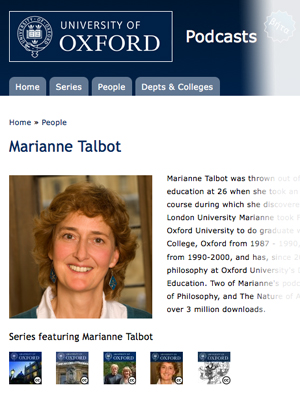
The Department for Continuing Education was one of the first departments to contribute to Oxford’s iTunes U site and Marianne Talbot, the Department’s Director of Studies in Philosophy, has had her lectures downloaded more than three million times with two of her podcasts – ‘A Romp Through the History of Philosophy’, and ‘The Nature of Arguments’ – being global number one on iTunes U. You can listen to Marianne’s lectures and other podcasts from the Department’s podcasts site.

As well as contributing to the University’s open education initiatives, the Department has undertaken research into the use of open educational resources by tutors and students and, where possible, releases the outputs of its teaching and learning projects as OER.

One example is the Course Design Moodle, which highlights examples from some of the Department’s online courses and aims to help teachers worldwide to develop their own high-quality online learning resources.

The Department is also embedding open practices across its work and has just started an exciting new project to create OER as part of the Weekly Classes programme. So far, the project has made available more than 150 online resources from 11 weekly classes and will be openly licensing these resources in the future. For a preview of the sort of material we hope to release see: open.conted.ox.ac.uk/.

Questions of creativity

The Harvard based Berkman Center for Internet & Society recently published a report entitled ‘Youth and Digital Media: From Credibility to Information Quality’.  It uses a promising contextual framework to assess a broad body of literature focused on the information seeking behaviours of learners 18 years old or younger.

What I like about their approach is the use of  academic, personal and social as the overlapping contexts in which information is sought, shared and consumed. There are also useful distinctions made about the basis on which information is assessed with the phrase ‘adult-normative criteria’ often employed. The most encouraging part of the report for me is its attempt to explore the relationship between ‘information creation and dissemination practices’ and learners overall perceptions of information. Two of the areas that the report suggests are currently underexplored caught my attention:

1. “How increased levels of creative interaction with information shape users’ ideas of information quality and how they influence search and evaluation behavior.”

2. “How to leverage youth content creation and dissemination activities effectively from the
personal and social contexts for the academic context, and how to resolve the conflicts of
expectations and norms between these two contexts.”

Both of these areas are a key part of our JISC funded Digital Visitors and Residents project which is interviewing and surveying learners from four educational stages which span late-stage secondary school, through university, to experienced academics. By using the Visitors and Residents principle as an underlying framework I believe we are beginning to gain an understanding of the answer to question 1 and we are certainly discovering some of the key factors within question 2.

For me ‘content creation and dissemination’ would involve the expected blogging, media posting and commenting etc but should also include tweeting, posting to Facebook and other forms of interpersonal contact/expression online. Content ‘creation and dissemination’ in this sense is closely linked to the notion of a Resident mode of engagement. This is especially relevant when considering the role of creativity as expressed in question 1 i.e. what is the individual contributing when they make, modify and/or share?

Plotting our participants engagement with the web along the Visitors and Residents continuum makes visible the common dislocation between these Resident style literacies often employed in a personal/social context and the more Visitor style literacies employed by learners academically. There are areas of cross-over such as what I have termed ‘Emergency Collaboration’ and the occasional participant who has an active professional/social network online. Generally however what we are finding is a range of ‘learner owned’ Resident literacies which are not officially valued by higher education institutions.

UKU3 map

V&R mapping of a UK university participant showing a distinct division between 'Institutional/Visitor' and 'Personal/Resident' activity.

It could be argued that this is not a problem and that Visitor style approaches are what we should reasonably expect to employ during our formal studies. However, if as the Berkman report suggests an ‘increased creative interaction with information’ has a positive influence on learners ideas about information and how to find it then understanding and ‘leveraging’ Resident literacies becomes extremely important.

The first of our 4 educational stages is the ‘Emerging’ stage which includes late-stage secondary school (from 17 years old) through to first year undergraduates. I was keen to include this ‘bridging’ stage in the project as I felt that historically there had been too hard a distinction between the educational research carried out with schools and that carried out with universities. It was almost as if we thought of these learners as two different species rather than individuals who normally only have a gap of a few weeks between these two forms of education. Our early findings indicate that learner’s information and digital literacy practices do not alter significantly as they enter university. This is why it’s so important for the higher education sector to take note of reports such as this, reports that give an insight into the information and digital literacies of incoming students who are unlikely to significantly modify their approaches to the web in their first years at university.

Learning from OER research projects

The iceberg of reuse

Another chance to consider the iceberg of reuse

I recently visited the OU to present on the OER Impact project for the SCORE‘s session on learning from OER research projects.

With proper social media credentials the entire day is on Cloudworks here http://cloudworks.ac.uk/cloudscape/view/2375  this contains both the slides and  a video of all the presentations of the day so you to can experience it as though you were there (although the video is not currently working for me).  If you already think you know enough about our study I would recommend in particular viewing the talks from Alison Littlejohn and Patrick McAndrew talking respectively on the findings from the OER Project evaluation and synthesis and the OLnet project.

Visitors and Residents – an update

Last week myself and Lynn Connaway of OCLC gave an update on the JISC funded Digital Visitors and Residents project for the JISC Developing Digital Literacies programme. It was an online session with a healthy flow of text-chat discussion/banter.

Thanks to the support of the JISC infoNet folk the session is also available to play back ‘live’ or in audio form. Dr. Bex Lewis (@drbexl/@digitalfprint) also constructed some very useful live notes which contain key screenshots and links.

A number of themes/questions emerged from the session some of which Helen Beetham has captured in a blog post which I have reproduced (including comments) with very minor edits below. The ensuing discussion in the comments (possibly) demonstrates how closely the notion of digital literaces is tied to fundamental conceptions of education and the function of universities. I wonder if this is because taking a literacies approach helps to direct discussion away from simplistic tech = efficiency notions which often lurk within teaching and learning related projects?

The Digital Visitor and Residents project will report on its activity and findings in phases 1 and 2 towards the end of January. The report extends much of what is discussed in the online session by suggesting the implications of our findings for the sector. As the project progresses into its 3rd phase next year we hope to evolve these implications into pragmatic recommendations for the sector. In the meantime we will continue to raise themes that we think are of value as we discover them in our data.

——————————————
Taken from HelenB’s e-learning blog
http://design-4-learning.blogspot.com/2011/12/digital-visitors-and-residents-some.html

Digital visitors and residents – some thoughts

I took part in an online seminar on the Digital visitors and residents project at a Collaborate seminar organised by the JISC last week. I think this is a useful metaphor to have in play, and the findings of the project which look extremely valuable in extending our understanding of what motivates students to engage in the digital environment. There are obvious links with the JISC Developing Digital Literacies programme: by helping explain what strategies students are using, the project can help us understand what educators might do to validate or further develop those strategies, or introduce others that might give students greater repertoire and fluency.

Some of the early findings obviously replicate work that has been done in the past to problematise the digital natives narrative, to demonstrate that personal/social skills with technology are not highly transferable to learning, and to recognise that students have many strategies for using technology to support their studies which do not necessarily coincide with what institutions see as ‘good’ study skills (the Learners’ experiences of e-learning studies confirmed both of these).

I do have some thoughts about the metaphor itself, which I shared at the seminar. For example:

  • Is the place vs tool metaphor one that the project is using, or one they are finding that participants use in thinking about the online space?
  • How far is the metaphor a design artefact of the environment and how far is it a property of the individual’s stance towards the environment? For example, ‘windows’ are intuitively spatial. Drop down menus are intuitively tool-like. Most software interfaces combine both to give different messages to the user about how to behave.
  • We know that people’s behaviour in online environments is very strongly influenced by those environments – arguably more than any innate factors including age, confidence with technology etc. At least, it is a question that can be researched: to what extent is behaviour in online environments an aspect of relatively stable aspects of the person and to what extent it is environmentally determined? This might vary depending on the environment in question (and even on the person??)
  • I am assuming that the metaphor distinguishes behaviours and not individuals. i.e. we are all visitors and residents in different contexts.
  • As described in the seminar, the visitors-residents continuum seems to combine a range of behavioural and perceptual aspect: the metaphors we use when we engage with technology; whether we are behaving as individual or social participants/learners; whether we are behaving as consumers, collaborators or producers of content etc. There is an empirical question here: to what extent are these different factors linked? Is this a question the project is trying to answer?

One of the dimensions along which visitors and residents were said to differ is whether their behaviour is ‘instrumental’ or ‘networked’. For me, the web 2.0 era is essentially one in which to be networked IS to be instrumental. Asking a question of my twitter followers is me being instrumental. In exercising my agency I recognise the value of collaboration.

So, this post is meant to open a conversation that I hope will be a productive one!
Posted by HelenB at 03:25

7 comments:

David White said…

These are all very useful questions that contribute to what is an evolving idea.

My experience is that at the simplest level people find the V&R continuum helpful in coming to an understating of their own practice. Often it becomes a useful validation of Visitor style approaches (Yes, this is about behaviour and context) and counters some of the more damaging aspects of techno-evangelism that circulate.

In answer to the ‘environment’ question I find Google Docs is a useful example: When I’m using Google docs I tend to engage with it in exactly the same manner as I would Microsoft Word – to me it’s a tool (I act in a Visitor mode). However, as soon as somebody else appears and starts to edit alongside me the tool becomes a ‘space’ and my engagement with it shifts (My mode of engagement becomes more Resident). So my notion of ‘space’ is somewhere-where-there-are-other-people. My ‘Social Threshold’ post goes through this is a bit more detail: http://goo.gl/b0il2

Your point about the possible stable aspects of a person vs environment is a tricky one because, for example, I will lurk in Twitter sometimes and sometimes I will be active. It depends on what I stand to gain and the context of the moment. So I don’t think it’s possible to develop a fixed model of person + environment = mode of engagement. It may be possible to develop the most probable mode of engagement given certain factors which is something I hope the project will be able to address.

Yes there are a lot of factors here and rather than become too entangled in them I try to cut the Gordian knot by always asking what the learner thinks they are trying to achieve – why did they choose to engage in a certain way? Having said that, I’m very interested in exploring possible links between Visitor and/or Resident modes of engagement and the way in which learners perceive the process of learning itself.
14 December 2011 08:55

HelenB said…

Nice comment Dave, and thanks for adding more detail to the V&R analysis.

I like the nuanced metaphor you are offering and I especially like that it is a useable one (it is a tool for understanding what we do/who we are, therefore a Good Thing to have). But deep down I suppose I believe that the really important difference between people in all their spheres of action is one of capital/power. Despite all the rhetoric to the contrary, the internet’s knowledge resources are no different from other resources of intellectual capital in this respect. If you are already reasonably well endowed, you perceive it as a tool, a space, a library, an extension of personal agency. If you are not, you perceive it as a place to shop and watch other people’s home videos. Or perhaps you see it as frightening, disempowering, a labyrinth, a pit of immorality. Arguably, the internet just makes it easier for those who know what they want to know to find it, and those who already know who to know, to build their networks.

So how people behave – and the metaphors available to them for understanding their own behaviour – for me always have to be seen against that larger picture and the metaphors should not take on a life of their own.

Also I think we need to be aware of devices, interfaces and services as designed for use (design as a means of achieving power over the user as well as providing a service). They have designs on us, even though we can appropriate them for our own ends individually and collectively. So perhaps for me a sign of digital literacy development would be (a) an awareness of the metaphors we are being offered as users, as being the first step to a conscious adoption or resistance to them (b) a capacity to generate alternative metaphors as users, and (c) eventually a capacity to design new metaphors for ourselves and others by developing (co-developing) new interfaces, communities, networks, and uses. I’m not sure how this trajectory maps to the visitor-resident continuum.

Seb Schmoller has this evening drawn my attention to a nice article on the digital divide in Scientific American: http://blogs.scientificamerican.com/guest-blog/2011/12/14/digital-divide-and-social-media-connectivity-doesnt-end-the-digital-divide-skills-do/
14 December 2011 12:45
David White said…

The learners we have been interviewing are predominantly driven by convenience, this is their primary reason for engaging online even when they know that what they might find is only going to be ‘good enough’ and that other sources or places might be ‘better’. It is interesting to consider how much power we are prepared to give up to devices and services in the name of convenience.

I agree that it’s important to make visible the age old power/capital situations which are being mirrored online. In my opinion learning how to ‘see’ media and the internet in these terms is an important literacy. This, I think, is especially important for those looking to gain credibility or power via Resident style approaches. Having said this I don’t see the value of focusing directly on inequalities online. I can attest to the fact that it’s much easier to get to the information in Wikipedia than it is to get into the Bodleian. What makes me suspicious is the denigration of extremely accessible forms of knowledge online by those who currently hold positions of intellectual power. – My point being that the web is in some ways so empowering that we occasionally find it culturally unacceptable or perhaps we find it difficult to adjust to the new ways in which power can flow.

The Visitors and Residents metaphor is a relatively basic tool for unpicking the complexity of our engagement with technology and, possibly more importantly, our engagement with others via technology. As with any metaphor it can only be taken so far before it fractures but it is proving to be a useful lens for coming to an understanding of how learners are appropriating (and being pushed around by) technology. It has also been useful in understanding why certain institutional technological interventions/services fail even though their web based counterparts are highly successful.

I have seen the metaphor appropriated in a variety of ways and had useful conversations around the different contexts it can be used in. For me it’s value is the understanding it facilitates.
15 December 2011 02:14

Martin Oliver said…

“How far is the metaphor a design artefact of the environment and how far is it a property of the individual’s stance towards the environment?”

…presumes a neat division exists between the two, whereas elsewhere in the post (e.g. in relation to visitor in one context, resident in another) the two intertwine in a much more ANT-like way.

I tend to wonder, how much is the metaphor recognisable to an individual, given their previous experiences – and is it so recognisable that they fail to notice it? So – like some of the other learner experience work – I’m really curious about the way biographies shape our ability and inclination to read and use what we encounter.

Really liked the point about the Internet as tool/space/shop/scary labyrinth. As you say in the original post, being really ‘digitally literate’ could or should include being able to read such metaphors in a critical way, and even construct alternatives. I was in a digital literacies meeting today (http://blogs.ubc.ca/newliteracies/) where Mary Lea made a passionate plea not to loose that critical tradition in digital literacy work – a plea made because it seemed to be getting lost in the more skills/cognition take on digital literacies that was at the fore in several of the presentations.

BTW, in relation to the presentation – it may just be me worrying unnecessarily, but I really hope that the interest in demographic prevalence analyses doesn’t re-create the native/immigrant binary by the back door.
15 December 2011 12:04

HelenB said…

Thanks Martin for adding your voice to this exchange. I don’t think I disagree with anything David is saying: I think it’s just a matter of emphasis. Yes, ‘it’s much easier to get to the information in Wikipedia than it is to get into the Bodleian’, but let’s not elevate this to a ‘new pedagogy’ or imagine that it abolishes other inequalities of access. Critical thinking and acting requires more than information. Universities are not the only source of critical thinking in/of/about digital media, perhaps not even the most influential but let’s define what Universities ARE good for in this age of information. For my money it’s public/open scholarship plus developing digital literacies of the critical variety.
For a fabulous example of both, here’s a web site/activist project/geography programme at Exeter that I’ll be learning more about tomorrow. I can’t wait:

Another kind of shopping


http://www.followthethings.com/FIY.html
15 December 2011 13:28

David White said…

I use the Visitor and Resident metaphor as a method of understanding what is going on out there in terms of practice. I try not to be too prescriptive about the actions that could be taken having gained a better understanding (although I’m happy to make suggestions 🙂

For me the skills/cognition route is an odd one given that we are supposed to be ‘higher’ education. It hints a an underlying learning-technology-as-a-machine mindset. This is where I think the ‘web as a space/place as well as a tool’ idea can be useful in encouraging a critical approaches.

@Martin I’m trying to avoid a demographic based analysis by talking about Educational Stages not age. It’s complicated by the fact that most undergrads are between the ages of 18 and 21 so the notion of educational context and age tend to be coupled. Ideally I would like to extend the project to investigate a wide range of lifelong learners. This should lead to results which break the educational context – age link. Within the current project we have tried where we can to interview a-typical students within the educational stages but our sample is quite small so I’m not convinced this will be enough to counter the problem.

@Helen What is interesting me is the extent to which learners are developing their own literacies and the extent to which they can access information outside of traditional contexts. Much of what is happening isn’t new in essence (as we so often find once we decide that something being ‘digital’ doesn’t automatically make in ‘new’) but the scale of activity has powerful implications.

Overall the message is very encouraging. Time and time again learners indicate their desire to be taught and to improve their critical thinking. There is a huge respect for the idea of the university and for the expertise that it represents. It reminds me that while the sector should understand it’s position relative to the web and the ‘network’ it needs to hold true to it’s tradition of critical thinking and of disrupting lazy world views.
16 December 2011 01:59

——————————–


The Learning Black Market

Last week I gave a talk about what I call the Learning Black Market at a Guardian seminar on the uses of Social Media for learning and teaching in higher education. It’s something that I have seen emerging from the data we are collecting for the Visitors and Residents project and from interviewing students for our study on the use of Open Educational Resources. In simple terms students personal use of the internet is generally very effective for their education but they are nervous that their practices are not valid and don’t reveal them to their tutors. The messages or lack of messages from educational institutions on these practices is generating a learning black market which masks the sheer scale of these new modes of engagement.

Scott Room at the Guardian

Printing press outside our Guardian seminar room

The Visitors and Residents project is capturing student’s motivations to engage with the web for learning in as broad a manner as possible. To guide our understanding of the interviews with students in the UK and the US we have added a vertical axis (see below) to the Visitor and Resident continuum. The Personal/Institutional axis allows us to plot student’s online learning activity and accepts that this activity is not bounded by resources and opportunities provided directly by the institution they are studying at. As the project progresses we hope to plot students trajectory through this digital landscape. It should also be possible to use this map as a tool to reflect on institutional approaches to digital literacy.

The learning black market exists largely in the Personal area of the map. Our data from the Transitional education-stage (Late stage secondary school + first year undergraduate) is indicating that learning activity in this area has two main elements:

Vistors and Residents map

1.    Emergency collaboration

Many of the students we have interviewed wait until the night before coursework is due then IM their friends in Facebook to confirm what they have been asked to do and to check they are taking the right approach. If they can’t find their friends in Facebook they text them to either ask for clarification or to encourage them to log-in to Facebook. There is an expectation that someone from their class will be in Facebook when they need them which is one of the reasons that coursework can be left to the last minute. I suspect that Facebook IM is used extensively for homework as it’s convenient and immediate. It’s also private and a very low risk way of collaborating with a fellow student. The extent to which coursework is actually completed via this method rather than just clarified is difficult to assess. There is a lack of understanding amongst students as to what constitutes plagiarism in this scenario and a consequential wariness around discussing this type of practice. The line between collaboration and plagiarism is not easy to define and I believe students would benefit from this area being openly discussed. This practice is also an interesting reminder that much of the activity in Social Media is not visible. Wall postings and twitter streams only represent a portion of the activity in these spaces meaning that platforms such as Facebook are effective at facilitating Visitor style approaches.

2.    G.W.R.

The majority of students activity is information seeking, this could be via another person but is usually a more direct engagement with ‘content’. What appears to be a common practice (we are still in the process of analysing our data) is this very simple process.

Google > Wikipedia > References

A search on Google to help complete an assignment commonly returns a Wikipedia article. As we know Wikipedia articles are pitched at an ideal level and length to get a handle on a new subject which is something our Transitional students have to do a lot. The problem is that most of the students in the Transitional education stage we have spoken to in the US and the UK have been told not to use Wikipedia and so keep this practice a secret. A simple way to do this without losing the value of the platform is to cite the references attached to the Wikipedia article rather than the article itself.  This appears to be a very successful strategy for coursework but can be done without any substantive learning taking place.

Learning Black MarketThere appear to be two main reasons that students have been told not to use Wikipedia. The usual, culturally acceptable, reason is that it’s not accurate because ‘anyone can edit it’. It’s difficult to support this claim and as Jimmy Wales said recently the decline in Wikipedia editing activity is partly because many entries are now so accurate that only key experts could add to them. There are examples of what I would call knowledge vandalism but these tend to be so farcical that they are easily identified. Even so the students are wary of Wikipedia despite rarely finding it lacking when they use it:

“…a lot of the times teachers say don’t use .com or don’t use Wikipedia, they like hate when we use Wikipedia.  But Wikipedia is always right, so I always use that. “

The second and more telling reason which is rarely expressed is because it’s too convenient. One of the US students asked a tutor outright why they didn’t like Wikipedia and got this response:

“The problem with Wikipedia is it’s too easy.  You can go to Wikipedia, you can get an answer, you don’t actually learn anything, you just get an answer. ”

The tutor then goes on to say that the process of learning is about collating and critiquing multiple sources not simply taking in a correct answer i.e. the path you take in forming a new understanding is as important as the resultant knowledge. The very valid ‘show your workings’ standpoint.

Student at laptopThis is fundamental to the debate around technology and learning and the real issue at stake. Describing the web or Wikipedia as ‘inaccurate’ or negating the use of sources that have been written by multiple ‘non-expert’ authors has little impact on the actual practice of students (or the success of those practices). The debate should be around how we evolve educational processes to take advantage of or to account for these new forms.  We cannot continue to teach the literacies that have been the mainstay of the educational system in their current form because the web smashes traditional paths to understanding.

There are good examples of the ways in which the web can be used to facilitate learning, new approaches which accept the situation has fundamentally changed and that learning is now less likely to be the result of successful information seeking. Many of these methods involve a more Resident approach to negotiating understanding and use classic scholarly notions of discourse to encourage learning over and above the now largely redundant retention of knowledge.  Unfortunately it appears that many practitioners are turning a blind eye to these issues and are stigmatising emerging learning practices by simply banning talk of platforms such as Wikipedia.

“They don’t fail you but you get ridiculed in front of everyone for sourcing Wikipedia.”

This is generating the learning black market in which is it all too easy to simulate understanding for coursework and formal assessments. Worse still, it is a market in which genuine learning can take place but is not being recognised because resources and practices are not seen as valid and therefore do not become visible to the formal education system. Students have told us that they learn from Wikipedia but also skim read the textbook to cover their backs in case they are asked a direct question…

Whatever the case it is clear that students need guidance on how to engage with the web for their learning and would greatly benefit from clearer messages around what it means to learn in the twenty-first century and how their practices may or may not intersect with the formal educational frameworks they find themselves in.


Images:
Scott Room – David White – CC attribution
Visitors and Residents map – CC attribution
Learning Black Market – Gilderic http://www.flickr.com/photos/lanier67/5253473681
Student at laptop – cindiann http://www.flickr.com/photos/trucolorsfly/438068232/

Link curation at scale

The weakest link

http://www.flickr.com/photos/darwinbell/465459020/

In our report OER: The value of reuse in education,  we focused our attention on the reuse of online resources whether licensed or not .  There was no doubt that making no distinction between licensed OER and stuff on the web reflects the experience of the majority of HE practitioners, who use “stuff” relatively indiscriminately in low risk contexts.

However when not writing reports we develop and deliver a large portfolio of online courses  where we make extensive use of online resources.  These are mainly from large institutions such as other universities, or museums, but very rarely cc licensed.  As a result we mainly link out to these rather than incorporating them into course materials, as clearing copyright at that scale is not manageable as we know from our Mosaic project.

We are currently launching to over 1200 students, something that brings home the value of open licensing in purely pragmatic terms.  50+ courses a term, with between 5 and 300+ links per course checked 3 times in the lead up to  a course run  = a lot of work. Obviously we have tools that automate this up to a point, but they only tell you whether a link is live, not whether it ends up where you expect, and then there is what you do when a link is broken……This is a major overhead and it is getting worse.  A colleague suggested this post should be called “This has been a *@#! term for links”

So yes licensing is complicated and we should not see it as the be all and end all of OER, but when open licenses are  in place, by letting us bring resources into our course so we don’t have to check thousands of links each term, they allow us to design and deliver better courses. Long may it continue.

Image: the weakest link / darwin Bell / CC BY-NC 2.0


Disappearing digital resources

One of the most striking aspects of our JISC funded Open-Educational-Resources Impact study was the extent to which using digital resources has become embedded in teaching practice. Digital resources are ‘disappearing into use’ as they become part of the fabric of higher education.

We interviewed strategists, academics and students to find out how they found and used digital resources. It wasn’t surprising to find that students were Googling for anything they could get their hands on but the extent to which academics are doing this as well was unexpected. The difference between the groups was that staff have the expertise required to critically evaluate what they find while the students are nervous about waiting-time using resources which might prove to be off-topic. They are also uncertain of how to cite non-traditional resources or if they should admit to using them as all. This is a good example of where digital literacy and traditional research skills are both essential.

But what about licensing? Well, those whose practice was highly visible on the web and therefore closely tied to the reputation of their institution were keen to use openly licensed materials. E.g. an online distance elearning team or groups that make modules which are rereleased out onto the web. Those in course or programme teams were less focused on licensing because their practice is largely private – within the VLE, in the lecture theatre etc. In day-to-day teaching the technicalities of reuse come second to the potential of a resource to make the student’s learning experience richer.

The OER Impact project analysed the link between the value of use and its impact in teaching and learning. There is a full research report and a shorter ‘accessible’ report available for download from JISC. Or you can watch the short video below to get an overview of our findings.

The video is published under a Creative Commons Attribution licence (CC BY)

OER Impact project team-

Technology-Assisted Lifelong Learning:
Mr David White
Ms Marion Manton

Learning Technologies Group:
Dr Elizabeth Masterman
Ms Joanna Wild

The cost of Residency?

We like to think of online platforms usurping each other as we move to the latest and greatest of a particular format, leaving the previous version eroding in a Kipple like fashion – the MySpace to Facebook to Google+ narrative. I’m not convinced that this is a useful story and wonder if the web is better thought of as an ever expanding space rather than a migrating community. I suspect that Google+ for example will be inhabited by more than the diaspora from Facebook and Twitter. In fact what interests me about Google+ beyond ‘circles’ is the way in which the platform has expanded the geography of social web so massively in such a short space of time.

Estate agent window smashed

Given this Google’s new platform highlights the impossibility of residing everywhere online, of having a live profile in all of the key places – it’s time-consuming to maintain a meaningful presence in one social media space let alone two or three.  To keep things practical you have to decide where you are going to reside online and have a reasonable idea of what role that residency will play in your life: personal, professional, academic, escapist or a delicate cocktail of the above (and we all know how dangerous cocktails can be). To counter the potential alienation of residing online it is useful to reflect on what your motivation to engage is: maintaining f2f relationships, living-out ‘strong-tie’ relationships, building a professional network, building a personal learning network or just good old fashioned self promotion in the hope of invites to warm places… Time is the non-negotiable cost to Residency and to maintaining fulfilling relationships of any form. The way this precious resource is spent, especially in the context of learning, needs to be better understood by those of us promoting the idea of digital literacy.

We are just coming to the end of the pilot phase of the JISC funded Visitors and Residents project framed round my original idea for understanding individual’s engagement with the web. The project is in partnership with the OCLC and for the pilot phase we interviewed students from the US and the UK in late-stage high school and first-year University. There are many interesting trends emerging from the project and it is the case that some students are more Resident than others. Most of our participants talked about the cost of being Resident online in some form which has led us to include ‘time-wasting’, ‘distraction’ and ‘addiction’ into the code-book we are using to analyse the interviews.

I thought like coming into A levels, I’d need to be able to focus without having Facebook at the back of mind, because at GCSE, you know when you have coursework, I’d always go, okay I’ll go on Facebook, I’m going on MSN, I’d just stay logged in and then I’d do my coursework on the side, but I just ended up staying on Facebook.

UKS6

I live on my email and Facebook also, which I’m not as proud of.  Just because it’s a time vortex.

USS3

I am not that bad with Facebook but I get annoyed sometimes … I find myself being on there for more than 15 minutes or 20 minutes. It is pointless, it is a waste of time and then I think sometimes I get annoyed with how long I can spend on the computer when I could be probably doing something else.

USU1

Essentially if your normal mode of operation is mainly Resident then it’s difficult to go online and get on with activities that require a Visitor approach without checking-in to all your Resident spaces and risking distraction. The participants in our study are well aware of this and one even put her Facebook account on ice so that she could pursue her learning more effectively. It’s a tough decision though as much homework is discussed and possibly collaborated on (participants are always wary of this idea as it is unclear where collaboration merges into plagiarism) in Facebook IM. If your friends aren’t logged into Facebook at that moment then a text message goes round asking them to get online so that work can be tackled.

People do post a Facebook thing so and saying something like, “Everybody in my Biology class, what was it we were supposed to be doing?”

UKS8

Like usually with homework I usually can do it myself.  But like, like sometimes I will just like IM my friend on Facebook and will be like, “Hey do you know how to do this?”

USS6

Facebook messaging has really replaced email in the lives of students.  So that’s – if it’s more something that we’re trying to structure and actually build upon over some time, it would be a Facebook message…

UKU5

When the Visitors and Residents idea is discussed it is often with the implication that becoming more Resident or facilitating that process is going to be of value. In my video discussing V&R I make the point that a Visitor approach to formal education is more likely to be successful than a Resident one given that all students are likely to end-up isolated at a desk in an exam room at the end of their courses – i.e. the education system assesses our ability to be Visitors not Residents.

We also have to consider which mode of engagement is most appropriate for the world of work and perhaps more importantly which mode best supports individuals as citizens or as members of a range of communities? Thinking in terms of mode-of-engagement is one way of framing our approaches to digital literary– the definition of this as taken by the JISC strand of digital literacy projects being appropriately broad:

“..digital literacy defines those capabilities which fit an individual for living, learning and working in a digital society..”

Characterising digital literacy as a  simple drive towards Residency would be dangerous; digital literacies are required and acquired as much at the Visitor end of the continuum as they are at the Resident. If we are attempting to support students and equip them with relevant digital literacies we need to be more precise about the value of ‘just-visiting’ or ‘moving into’ particular online spaces. Our project is mapping motivations-to-engage and evaluating a wide range of approaches.  I’m hopeful that we will be able to develop methods by which individuals and groups can plan their travels through the ever expanding online landscape.


Image credit:  CC – Some rights reserved http://www.flickr.com/photos/pigsonthewing/3241588102/

Maths in the City website re-launches with new features

As a prelude to announcing the competition winners, Maths in the City is happy to announce the launch of an updated website.

Visit the interactive map on our homepage and go on a mathematical tour of cities around the world. Join the adventure today and shine a mathematical spotlight on your city.

Amongst the top new features we’ve added are:

  • New homepage: find maths in your city and around the globe using the interactive map
  • Maths in the City competition entries: these sites are now visible. If you entered our competition, find yours and send the link to your friends and family
  • Snapshots: this is a new kind entry that you can add to the map, see this page for details
  • Rate Sites and Snapshots: you can now rate Sites and Snapshots using our new five star rating feature – log in to start rating your favourites
  • “Recommended” content: gold icons indicate a Site or Snapshot that has been approved by a Mathemagician because of its high quality, see this page for details
  • Improved image uploader: it is now easier to upload images into your Site or Snapshot
  • Improved equation display: if you’re including mathematical equations in your Site or Snapshot, they will display better. For those of you who like knowing this kind of stuff, we’re using MathJax to support LaTeX